

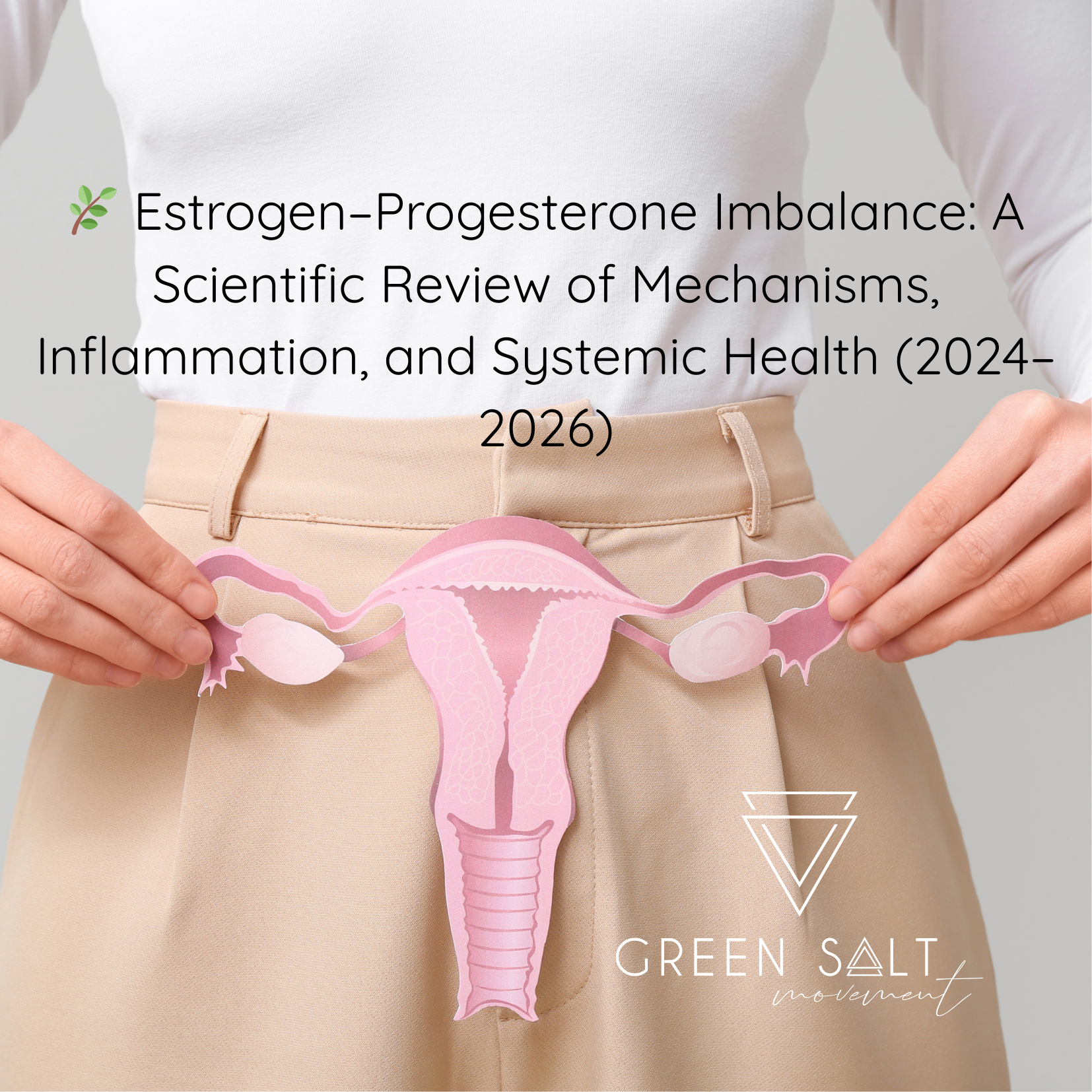
🌿 Estrogen Dominance: A Scientific Review of Hormonal Imbalance, Inflammation, and Metabolic Health
🌿 Estrogen–Progesterone Imbalance: A Scientific Review of Mechanisms, Inflammation, and Systemic Health (2024–2026)
Introduction
Sex steroid hormones—particularly estrogen and progesterone—play a central role in regulating reproductive, metabolic, neurological, and immune systems. Recent literature has shifted away from simplistic interpretations of “high oestrogen” toward a more nuanced understanding of hormonal imbalance as a dysregulation of oestrogen–progesterone signalling, receptor activity, and systemic physiology.
This review synthesises findings from 10 peer-reviewed scientific articles (2024–2026) to examine the mechanisms and clinical implications of oestrogen dominance (i.e., relative oestrogen excess compared to progesterone).
1. Hormonal Balance Is Defined by Estrogen–Progesterone Interaction
The endometrium is tightly regulated by cyclical fluctuations of oestrogen and progesterone, which coordinate proliferation and differentiation.
- Estrogen promotes tissue growth
- Progesterone counterbalances with differentiation and anti-proliferative effects
👉 Disruption of this balance leads to abnormal tissue responses and disease.
2. Estrogen Dominance Is a Functional Imbalance, Not Just Elevated Levels
Recent research emphasises that imbalance can occur even when hormone levels are “normal.”
- Disease states are linked to relative imbalance and signalling dysfunction, not just absolute hormone levels
👉 This supports clinical observations where symptoms exist despite “normal labs.”
3. Progesterone Deficiency and Resistance as Central Drivers
Emerging literature shows that many conditions involve progesterone resistance, not just low levels.
- Impaired progesterone signaling disrupts endometrial regulation and fertility
- Leads to persistent estrogenic stimulation
👉 This reframes “estrogen dominance” as often a progesterone problem first.
(Supported across endometrial and reproductive biology reviews)
4. Hormonal Imbalance Drives Inflammation
A 2025 review in Placenta highlights the interaction between hormones and immune signaling:
- Hormonal imbalance alters immune regulation
- Promotes chronic inflammatory responses in reproductive tissues
👉 This confirms that hormone imbalance is also an inflammatory condition.
5. Estrogen–Progesterone Imbalance and Neurodegeneration
A 2025 Nature Communications study demonstrated:
- Imbalance between estradiol and progesterone during perimenopause
- Leads to energy dysregulation in the brain and increased Alzheimer’s risk
👉 This is a major finding:
Hormonal imbalance affects brain metabolism and neurodegeneration.
6. Estrogen Influences Brain Structure and Plasticity
A 2025 Nature Neuroscience paper showed:
- Different hormonal environments produce distinct structural changes in the brain across the cycle
👉 Hormonal imbalance is not just symptomatic—it physically alters brain structure.
7. Estrogen and Adipose Tissue Dysfunction
A 2025 review in International Journal of Molecular Sciences found:
-
Estrogen-sensitive disorders like lipedema involve
- adipose dysfunction
- inflammation
-
fibrosis
- Linked to estrogen receptor imbalance and local estrogen production
👉 Fat tissue is hormonally active and contributes to imbalance.
8. Hormonal Imbalance and Metabolic Dysfunction
Recent systematic review (2026) in Human Nutrition & Metabolism:
-
Diet influences estrogen levels via
- aromatase activity
- SHBG
-
hormone metabolism
-
Hormonal imbalance linked to:
- metabolic disease
-
cardiovascular risk
👉 Confirms the nutrition–hormone connection.
9. Estrogen–Progesterone Imbalance in PCOS and Fertility
A 2025 clinical study shows:
- Hormonal imbalance affects ovulation and pregnancy rates
- Altered estrogen–progesterone ratio impacts reproductive outcomes
👉 Fertility is directly dependent on hormonal balance, not isolated hormones.
10. Hormonal Signaling Is a Systemic Network
Across all studies, a consistent theme emerges:
-
Hormones interact with:
- immune system
- metabolism
- brain
-
adipose tissue
👉 Hormonal imbalance is systemic, not isolated.
🌿 Key Scientific Conclusions
Based on current literature:
✔ Estrogen dominance is best defined as relative imbalance (E:P ratio)
✔ Progesterone plays a protective, anti-inflammatory role
✔ Hormonal imbalance contributes to:
- inflammation
- metabolic dysfunction
- neurodegeneration
- reproductive disorders
✔ Hormones act within a whole-body network, not independently
🌱 Integrative Interpretation (Aligned with Functional Medicine)
The scientific literature strongly supports that hormonal imbalance is influenced by:
- Inflammation
- Nutritional status
- Metabolic health
- Tissue-specific hormone signaling
- Brain–endocrine interactions
👉 This validates a systems biology approach, rather than symptom-based treatment.
📚 References (Peer-Reviewed Articles)
- Dias Da Silva et al., 2024 – Cells (Estrogen & Progesterone signaling)
- Yu et al., 2025 – Placenta (Hormones & inflammation)
- Sun et al., 2025 – Nature Communications (Neurodegeneration & hormones)
- Nature Neuroscience, 2025 – Brain plasticity & hormones
- Viana et al., 2025 – IJMS (Estrogen & adipose dysfunction)
- Elliott et al., 2026 – Human Nutrition & Metabolism
- Challab, 2025 – PCOS & hormone imbalance
- (Supporting mechanistic frameworks from endocrine signaling reviews)
- (Reproductive immunology integration)
- (Neuroendocrine integration)

Written by Gabriela Essado Cardoso

%0A%C2%A0%0AIntroduction%0ASex%20steroid%20hormones%E2%80%94particularly%20estrogen%20and%20progesterone%E2%80%94play%20...)
Leave a comment
This site is protected by hCaptcha and the hCaptcha Privacy Policy and Terms of Service apply.